



By now, many companies are using AI agents for analytics, but fewer than half of the insights those agents produce pay off.
According to the report, “Raising the quality of insights in agentic analytics,” from MIT Technology Review Insights in partnership with Snowflake, an average of 48% of insights generated by analytics agents lead to actions that improve the business. That’s up from 37% a year ago, but it still means more than half of agent insights are falling flat.
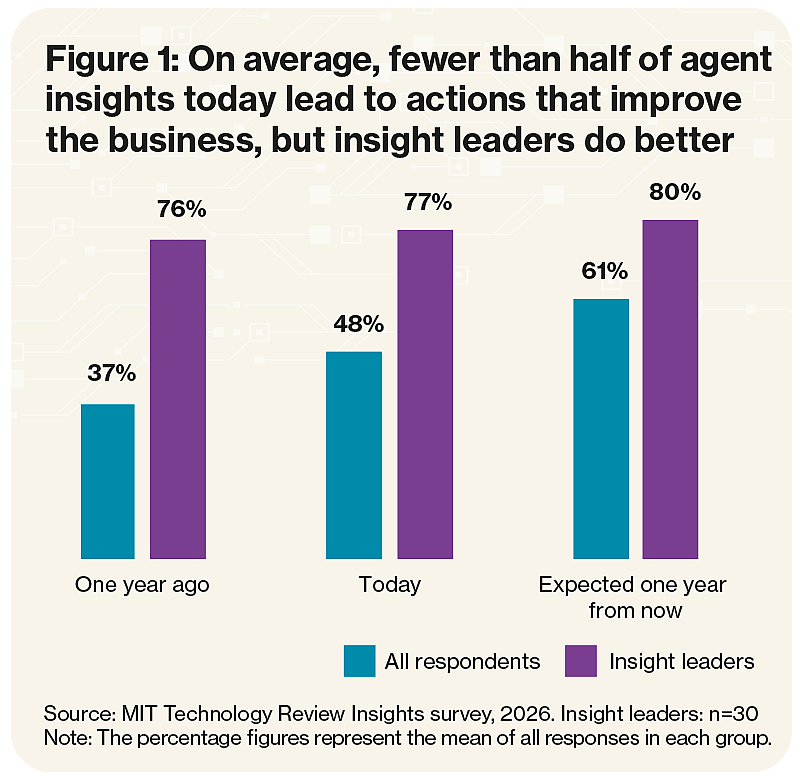
A common explanation for this shortfall is sheer volume. Working at machine speed, agents can create more output than any human can realistically review, and the survey supports some of that view: At 52% of the organizations surveyed, analytics agents generate too many insights to be properly evaluated and acted on.
Snowflake’s vice president of analytics Carl Perry, however, doesn’t think volume alone is the root issue.
“Agents certainly produce more output, and eventually that will need managing,” he says. “But treating volume as the problem right now leads organizations somewhere expensive.”
It involves building routing, triage and prioritization systems for insights that mostly don’t deserve the effort. “You end up with a well-governed pipeline for material that was never worth governing,” Perry says.
For Perry, the problem starts with the insights themselves. Agents have the data but not necessarily the knowledge that tells them what it means. Consider a term that nearly every company uses and yet cannot be universally defined: active customer.
“I am an active customer at the place where I get my car washed,” Perry says. “I go every six or eight weeks, which is exactly the rhythm they expect, and by their definition I’m in good standing. But if I went to my local grocery store once every six to eight weeks, there is no way I would be considered an active customer.”
Definitions can even shift between departments at the same company. A customer, for example, may not be considered “active,” according to the finance department, but they could easily meet the marketing team’s standards. A human can probably discern the difference, but an agent has no way of knowing which definition applies in which scenario.
The database won’t settle the question because there’s no column called “active customer” for an agent to turn to, only behaviors, dates and other identifiers. The definition is a judgment about the product, the sales motion and the market. At most organizations, no one has written that down. It exists in queries, BI reports, spreadsheets and in people’s memories.
Analysts have usually been the ones who carry that context in their minds. As agents take over query writing, however, the analyst role moves up the stack and gathers more importance. They will spend less time generating queries and building dashboards, and more time framing business questions, checking the agent against domain knowledge, and acting as part of the governance layer.
Perry calls the knowledge that analysts carry ambient context and considers it the most valuable analytical asset most enterprises own. But the problem is agents can’t see it.
The survey points the same way. Lack of business context and definitions is the top contributor to substandard agent insights, cited by 55% of executives, ahead of fragmented or inaccessible data at 45%. Among the 8% of organizations the report calls “insight leaders” — where more than 70% of agent insights lead to actions that improve the business — only 33% cite a lack of context.
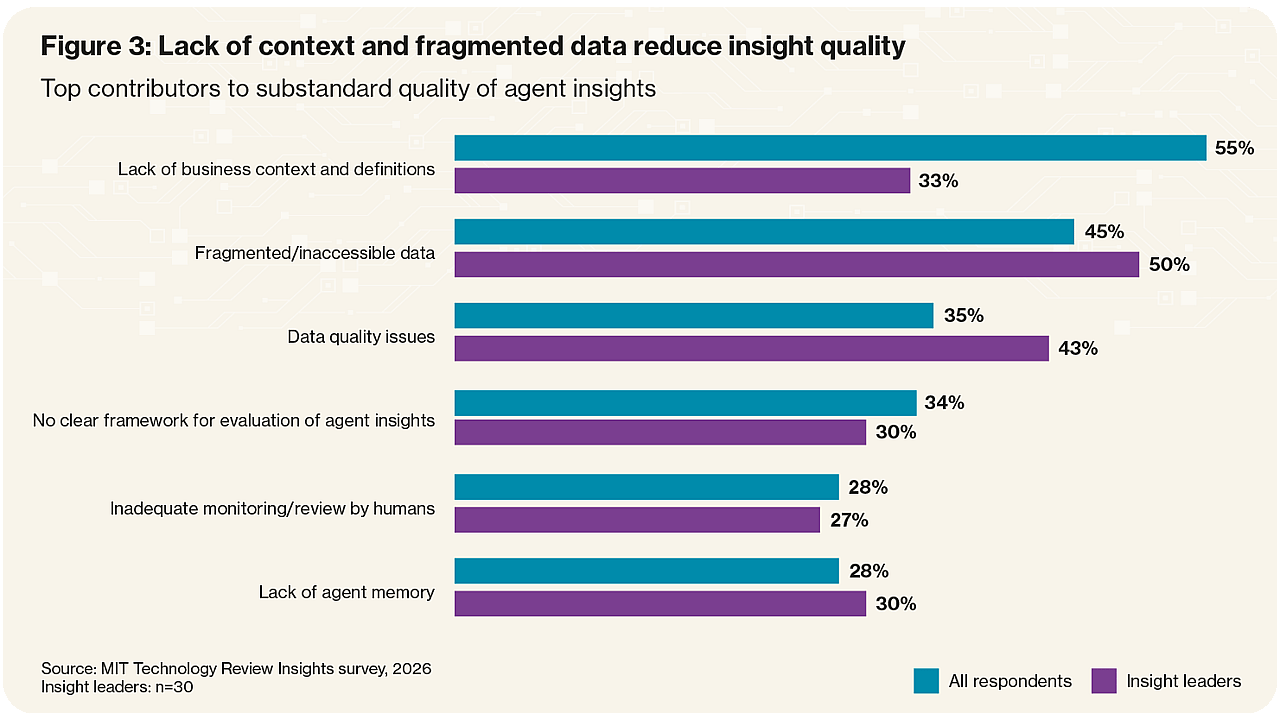
“An agent handed a well-modeled dataset and no context will produce fluent, plausible, unusable analysis,” Perry says. “Worse yet, it will do it quickly and at scale.”
The result is a trust problem: The software has to earn its place and be trustworthy.
Where these definitions do exist, they were built for a different job. Historically, the semantic model has lived inside BI tools. That worked because a person read the report, applied their own judgment and decided what to do.
AI systems change that. Ask the same question twice and you may get two different answers. That calls for more precision than the old semantic model was built to produce.
Perry says the questions that matter most need a single, verified answer. Teams also have to capture synonyms, because people use words that column names don't, and state relationships and metrics explicitly instead of leaving them for someone to infer.
That doesn’t really exist at many organizations, Perry adds, and when it does, it sits in a reporting tool, outside the systems where AI actually runs.
Large enterprises already run several systems that can generate analysis, and they will run more. If each one needs its own copy of the company’s context, every new tool means rebuilding institutional knowledge by hand in a new place and then keeping that copy accurate.
“That cost recurs, and it scales with your vendor count,” Perry says. “So if you feel as though you’re paying repeatedly for the same work, chances are you’re not imagining it.”
That’s why Perry argues the state of an organization’s context matters even more than which model it standardizes on. Context should live in a form that every system can share.
Perry compares this moment to the years after the invention of the printing press, when information became cheap to produce but indexes, libraries, catalogs and other search aids hadn’t yet made it easy to navigate.
“Buying the model is buying the press,” he says. “The harder, less exciting work is getting what your organization knows into a form that the system can use.”
Perry expects companies that do that work to eventually face the volume problem for real: hundreds of high-quality findings, all worth acting on, and more than any one team can realistically pursue.
“That’s a good problem,” Perry says, “and one that almost nobody has earned yet.”
This story was produced by Snowflake and reviewed and distributed by Stacker.


